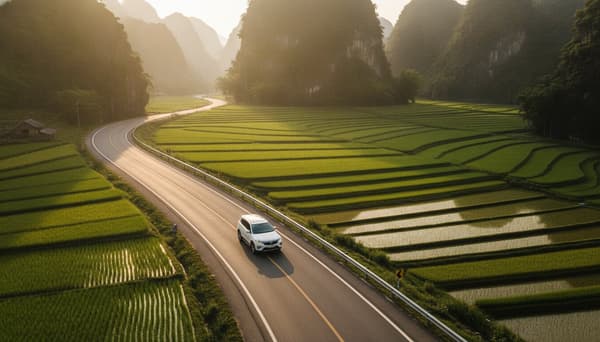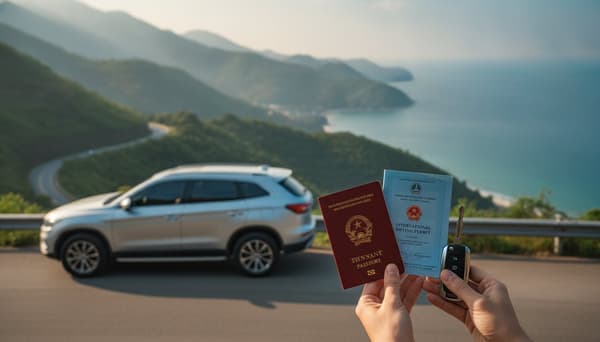
The short answer: yes, and it's straightforward
Foreigners can rent and drive a car in Vietnam as long as they show up with the right paperwork, meet the rental age requirements, and are comfortable with local traffic conditions. Most first-time visitors are surprised by how simple the booking and pickup process actually is — the harder part is feeling ready to drive yourself on unfamiliar roads. Rocket Car Rentals offers self-drive rentals only.
This guide is the one place for the three questions renters ask most: which licence and permit you need, which traffic rules are actually enforced, and how fines reach you. For the rest of the rental (costs, protection, pickup, routes) read Self-Drive Vietnam: The Complete Foreigner's Bible.
What you need to bring
- Passport — the physical document, not a copy or photo. It's required at pickup and rental staff will keep a copy on file.
- Your valid original home-country driver's license. Rocket Car Rentals does not require a minimum licence-holding period.
- An International Driving Permit (IDP) issued under the 1968 Vienna Convention, carried together with your home licence. It is valid for up to 3 years and only while your home licence is valid; 1949 Geneva IDPs are not accepted.
- The security deposit: 13.250.000–26.500.000 ₫ depending on the vehicle.
- Proof of your Vietnam address for the rental period — a hotel booking confirmation or Airbnb reservation is enough.
- The rental contract. The vehicle registration stays with the car, usually in the glovebox, and is handled by the rental company.
Rental companies will walk you through any additional documentation specific to your nationality during booking, so it's worth confirming requirements with the company directly before you fly in. Have a licence and want to double-check that it is valid in Vietnam? Our team will verify your eligibility for free before you book.
Keep photocopies of your documents in the vehicle and the originals safe but within reach, since police may ask to see them. Driving a car without a valid licence or IDP is fined 18.000.000–20.000.000 ₫ and the car can be impounded; showing an IDP but not carrying your home licence is fined 8.000.000–10.000.000 ₫.
Minimum age and licence requirements
- Rocket Car Rentals requires self-drive renters to be at least 18 years old.
- A valid original driving licence is required, with no minimum period of ownership. Some other rental companies ask for one or two years — check before you book elsewhere.
- Foreign drivers carry their passport, national licence and an International Driving Permit (1968 Vienna Convention), valid for up to 3 years and only while the home licence is valid. Not sure your licence qualifies? We verify your eligibility for free before you book.
Rules around licences and permits can change, so confirm the current position with the rental company before you travel. Keep your passport, licence, IDP and rental agreement with you whenever you drive.
Is self-drive right for your trip?
A self-drive car gives you full flexibility for road trips — coastal routes, mountain passes, day trips outside the cities. It suits confident drivers who are comfortable with dense motorbike traffic, especially in Hanoi and Ho Chi Minh City.
If you would rather not drive in a busy city, taxis, ride-hailing apps, buses, trains and domestic flights are widely available. Many travelers use those for the busy city stretches and rent a car for the scenic legs of the trip. See current vehicles and prices on the fleet page.
What to expect at pickup
Pickup usually takes 15-20 minutes. Staff walk around the vehicle with you to document any existing scratches or damage, confirm the fuel level, explain the toll-tag or fuel policy, and go over the return process. Ask for a printed or photographed condition report before you drive off — it protects both sides if there's a dispute at drop-off.
Rocket Car Rentals briefs every renter on local road rules at pickup, provides a bilingual rental contract and a verified inspection file, and keeps a support team on call around the clock. If you are confused by a restricted road sign, hit an electronic toll (VETC) error or get stopped by the traffic police, one call to the hotline gets you a team member who helps with the language barrier and the logistics.
The traffic rules that matter
On paper Vietnam's rules look like most countries' — drive on the right, stop at red lights, wear seatbelts. In practice, motorbikes make up most of the traffic, right-of-way is informal, and enforcement is moving to automatic cameras. These are the rules that matter for foreigners behind the wheel in 2026.
1. Speed limits — strictly enforced
Limits depend on the type of road and are posted, so always check the signboards, especially in residential areas and where road markings are unclear. As a guide for cars:
- Built-up (residential) areas: 50 km/h on two-way roads, 60 km/h on dual carriageways with a central divider. Lower where signs say so, for example near schools.
- Outside built-up areas: 80 km/h on two-way roads, 90 km/h on dual carriageways.
- Expressways (cao tốc): 60–120 km/h, set per section by the signs — limits change along the same route. Motorbikes are not allowed on expressways.
Speed cameras are common on highways and major arterial roads. Fines are issued automatically and mailed to the vehicle's registered owner, the rental company, which then contacts the renter.
2. Zero alcohol — no exceptions
Vietnam enforces a 0.00% alcohol limit for drivers. One beer is enough to trigger a heavy fine, and it is the rule that catches the most foreign visitors off guard, since many home countries allow a small limit. For a car driver the lowest level is 6.000.000–8.000.000 ₫ and 4 licence points deducted; the middle level is 18.000.000–20.000.000 ₫ and 10 points; the highest level is 30.000.000–40.000.000 ₫ plus a licence suspension of 22–24 months. Refusing the test is treated as the highest level, and the car can be impounded. Police run breath tests at random stops and at checkpoints most nights in the big cities, especially evenings and weekends. Plan a taxi or a ride-hailing app home — it is cheap.
3. Right of way: size and speed, not signs
Right-of-way is informal. The practical hierarchy: trucks and buses first, then cars, then motorbikes, then pedestrians. Trucks don't brake for cars; cars don't brake for motorbikes; do not expect cars to stop for you at a crosswalk. At intersections your turn is what you can safely take, not what a sign or light grants you. The golden rule is to be predictable: no sudden stops, and a smooth, steady pace lets the traffic flow around you.
- Motorbikes flow like water and fill every gap, passing on both sides. Keep at least 1 meter of buffer on each side when possible, use your mirrors continuously, and never open a door in traffic without checking for motorbikes.
- Look ahead: Vietnamese drivers rarely check blind spots. You are responsible for not hitting what is in front of you; the driver behind is responsible for not hitting you.
- Turning left against traffic is an art: don't wait for a perfect gap, nose out slowly and let the oncoming traffic flow around you.
- Covered riders: riders fully covered against the sun have limited peripheral vision. Give them extra space.
- The horn means "I am here", not anger: a short beep when passing, a double beep through an intersection, a long blast for a dangerous situation. Use it yourself when overtaking.
4. Seatbelts, phones, lights and lanes
- Seatbelts are mandatory for every occupant wherever the seat has one (800.000–1.000.000 ₫). A child under 10 and under 135 cm must use a suitable child seat and may not sit in the driver's row unless the car has only one row; seating the child beside the driver is fined 800.000–1.000.000 ₫, and a missing child seat currently carries a warning.
- Phones: holding a phone while driving is fined 4.000.000–6.000.000 ₫ and 4 points. Hands-free by Bluetooth is fine, and navigation is legal if the phone is mounted in a dashboard holder.
- Headlights: use dipped headlights at dusk and at night, and in rain or poor visibility; fog lights can be added when visibility is very low.
- Lanes: on expressways the slowest traffic keeps right and overtaking is on the left. Where signs or road markings assign lanes by vehicle type, follow them.
- Bus lanes: dedicated bus and bus rapid transit (BRT) lanes are closed to cars at all times (4.000.000–6.000.000 ₫ and 2 points). When in doubt, stay out of bus-only lanes.
- Parking is banned at no-parking signs, within 5 m of a junction, on bridges, on the left side of a one-way street and in bus lanes; it is usually fined 800.000–1.000.000 ₫, and a wrongly parked car may be towed. Park only in designated areas (blue "P" signs or a staffed parking attendant). Hotel parking typically needs pre-booking.
Fines at a glance
Vietnam raised its traffic fines on 1 January 2025 (Decree 168/2024/ND-CP). The amount you pay is the one on the official record, so treat these as approximate ranges for a car driver. "Points" are points deducted from the driving licence:
- Running a red light: 18.000.000–20.000.000 ₫ and 4 points; if it causes an accident, 20.000.000–22.000.000 ₫ and 10 points. Yellow means stop before the line unless you are already over it, so do not rush through.
- Speeding: under 5 km/h over is not penalised; 5 to under 10 km/h over, 800.000–1.000.000 ₫; 10 to 20 km/h, 4.000.000–6.000.000 ₫ and 2 points; over 20 to 35 km/h, 6.000.000–8.000.000 ₫ and 4 points; over 35 km/h, 12.000.000–14.000.000 ₫ and 6 points; if it causes an accident, 20.000.000–22.000.000 ₫ and 10 points.
- Drink driving: 6.000.000–8.000.000 ₫ and 4 points (lowest level), 18.000.000–20.000.000 ₫ and 10 points (middle), 30.000.000–40.000.000 ₫ plus a licence suspension of 22–24 months (highest, also for refusing the test).
- Entering a prohibited road or driving in the wrong lane: 4.000.000–6.000.000 ₫ and 2 points; a banned turn, 2.000.000–3.000.000 ₫; driving the wrong way on a one-way street, 18.000.000–20.000.000 ₫ and 4 points; if it causes an accident, 20.000.000–22.000.000 ₫ and 10 points.
- Illegal parking: usually 800.000–1.000.000 ₫ (2.000.000–3.000.000 ₫ on a bridge or on the left side of the road; 4.000.000–6.000.000 ₫ if it causes a jam), and the driver pays towing and storage.
- Serious violations: police can also impound the car, for example for drink driving or no valid licence.
Fines matter beyond the amount: travel and rental insurance usually require you to be driving within local traffic law at the time of an accident. Driving under the influence or ignoring a clear order can void your cover and leave you paying medical bills and vehicle damage yourself.
On the road: what police actually check
Vietnamese traffic police run both random checkpoints and fixed stops at highway entrances. If you are flagged down (tuýt còi), pull over safely, stay calm and polite — a smile helps — and expect a documentary check rather than an adversarial one:
- Passport — to confirm you're the person named on the rental contract.
- Driver's license and International Driving Permit (1968 Vienna Convention), carried together.
- Rental contract (sometimes requested).
- Vehicle registration — this stays with the car and is handled by the rental company.
Most checks take five to ten minutes and officers are generally checking that your paperwork is in order, not looking to issue tickets. If you really did speed or run a light, accept the ticket. Use a translation app if there is a language barrier.
Some officers may informally suggest settling a fine on the spot. That is not the official process and you are entitled to decline: politely ask for the official receipt (biên bản). The formal route can take longer, but the receipt protects you if there is a dispute later.
Traffic fines — how they reach you
Fines come in two forms:
- On-the-spot: paid directly to the officer with a receipt issued. Common for speeding, running a red light, or lane violations witnessed directly. Keep the receipt.
- Camera-issued: sent weeks later (typically within 2 to 4 weeks) to the vehicle's registered owner — the rental company — which then notifies you with a copy of the official record. You have 7 days to dispute it; after that the fine is collected from a deposit still held or via a payment link. Your card is never charged automatically, and there is no fixed administrative fee — only an actual, documented handling cost, if any.
This is also why the security deposit is held for a few weeks after you return the car: camera fines often reach the owner after the trip has ended.
Bottom line
Renting a car in Vietnam as a foreigner is routine as long as you bring the right documents and feel comfortable behind the wheel. The biggest real-world risks are speeding on expressways (automatic fines), the zero-alcohol rule (breath tests at checkpoints) and misreading motorbike right of way. Drive defensively, keep your documents with you, assume cameras are watching on every highway, and take it slowly on quieter roads before longer trips. If you'd rather skip driving on unfamiliar roads, taxis and ride-hailing apps cover most city trips.
Renting with Rocket Car Rentals? We check your documents at pickup and explain the deposit and return process up front. Our rentals are self-drive only. Our pickup safety briefing and the safe self-drive checklist go deeper on fines, fuel and charging, and checking the car.