Who this guide is for
This is the practical 2026 reference for renting a car in Vietnam and driving it yourself. Whether you're a tourist planning a 2-week road trip, an expat needing long-term mobility, or a digital nomad exploring Southeast Asia — it covers every decision from licence type to roadside breakdown, the full cost of a rental and how to avoid the common traps.
If you want the short answer: yes, foreigners can rent and self-drive in Vietnam legally with proper documents, but it's only a good idea if you have (a) a valid driver's license and the required paperwork, (b) experience driving in dense traffic, and (c) a clear route. For first-time Vietnam visitors staying only in big cities, taxis or ride-hailing apps are often easier than driving yourself. Rocket Car Rentals offers self-drive rentals only, from offices in Ho Chi Minh City, Hanoi, Da Nang, Nha Trang and Phu Quoc.
Why rent a car in Vietnam
A rental car puts you in control. Unlike tour buses that rush you through destinations or trains bound to fixed schedules, you can spend an extra hour at a hidden beach or stop at a roadside stall for authentic phở. Many of Vietnam's best places lie off the main routes and are practically out of reach without private transport: the forests of Phong Nha-Ke Bang National Park, remote villages in Ha Giang, the beaches of Ninh Thuan, the coffee plantations of the Central Highlands. For a family or a group of friends, one car also tends to cost less than booking separate tours for everyone.
Part 1: Legal requirements (what you MUST have)
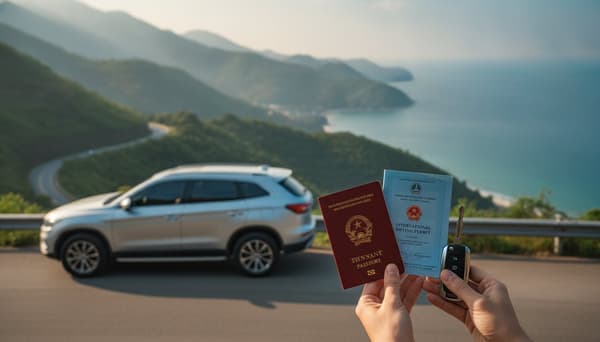
The documents every foreign driver needs in the glovebox:
- Original home-country driver's license. It must be valid. Rocket Car Rentals has no minimum licence-holding period; carry the original, not a copy.
- International Driving Permit (IDP). Issued under the 1968 Vienna Convention. Citizens of ASEAN countries are exempt from the IDP.
- Passport. The physical document, not a copy or photo.
- Rental contract. Vehicle registration is handled by the rental company (typically in the glovebox).
You must be at least 18 years old. Uploading your documents when you book is optional; have the originals with you at pickup. Rules around licences and permits change, so confirm the current position before you travel.
What happens at a police checkpoint: The officer checks passport → driver's license and IDP → rental contract. Usually 5-10 minutes, documentary only. If all documents are in order, you'll be waved through. If a document is missing or expired, you'll get a fine (4.000.000–6.000.000 ₫) and may be barred from driving until a valid license is produced. The full rules, fines and what to do at a stop are in our guide to driving in Vietnam as a foreigner: licence, IDP, traffic rules and fines.
Part 2: City-by-city difficulty rating
Not all Vietnamese cities are equally hard to drive in. Our subjective difficulty rating for first-time foreign drivers:
- Da Nang (Easy): wide roads, lane discipline, moderate traffic density. Good starter city.
- Da Lat, Sapa, Mai Chau (Easy): low density, rural roads. Just mind the mountain switchbacks.
- Phu Quoc, Mui Ne, Vung Tau (Easy): island/resort density, quiet roads.
- Hue, Nha Trang (Moderate): mid-size city traffic, manageable.
- Hanoi (Hard): dense traffic, complex one-way system, motorbike density. Old Quarter is a maze — avoid self-driving there.
- Ho Chi Minh City (Very Hard): 7 million motorbikes, permanent rush hour, 1-way streets change direction daily. Even locals have trouble. Strongly consider taxis or ride-hailing for city-centre trips instead.
Part 3: Choosing the right vehicle
Match the vehicle to the route, not to the flashiest listing photo.
- Compact cars are the right call for solo travelers, couples and trips within one city: easy to park, simple in narrow lanes and economical on fuel (roughly 5–6 L per 100 km). The trade-off is limited luggage space and a firmer ride on rough roads, so they are not ideal for mountains.
- Sedans suit small families and business travelers: comfortable and professional-looking, and good on the highway legs between cities, with higher fuel use than a compact.
- SUVs and seven-seaters suit families, groups, mountain passes and rural roads such as the Hai Van Pass or the Central Highlands, where road surfaces are inconsistent and the gradients are steep. They cost more to rent and to fuel; on a long trip a diesel version is usually cheaper to run.
Check the exact model on your booking page and confirmation, because "SUV" can mean very different cars. The price depends on the vehicle, the dates and the branch: live prices are on the booking page, in VND, and include VAT. Child seats and an additional driver can be added at booking; nothing is added to your price unless you select it.
Part 4: Booking, costs and the extras to check
Book 2-4 weeks ahead. Early booking gives you the vehicle you want, a clear price and time to plan your route. Last-minute bookings face thin availability and higher prices, and very early ones may miss seasonal rates. Avoid the peaks if you can: Tet (January–February) is the most expensive time and many businesses close, summer (June–August) is busy, and Christmas/New Year is a tourist peak.
What a Rocket rental includes and costs:
- Prices are shown in VND and include VAT; optional extras are added only when you choose them.
- Compulsory third-party civil liability insurance is included, as Vietnamese law requires. It covers damage to others, not your rental car, your own medical costs or theft.
- Mileage: rentals of 1 to 7 days include 300 km per day, and extra distance is charged at 5.000 ₫ per kilometre. Rentals of 8 days or more, including weekly and monthly rentals, have unlimited mileage. Longer rentals are often cheaper per day, so ask for a weekly or monthly quote.
- Security deposit: 13.250.000–26.500.000 ₫ depending on the vehicle, refundable. You can pay it in cash or by card at pickup or online. It is held after the return so that traffic-camera fines notified later can still be checked, and refunded no later than 30 days after you return the car; only amounts itemised in writing with supporting documents can be deducted.
- Payment: choose to pay 100% now or to pay at pickup. Cancellation is free more than 10 days before the scheduled pickup.
Extra costs to ask about with any rental company: whether the listed price includes VAT, delivery fees to a hotel or airport, mileage limits and the excess rate, one-way drop-off fees, cleaning fees and fuel terms. A rate that looks too good to be true is often offset by charges added at return.
Part 5: Damage protection explained
CDW and Full Protection are optional, paid, and are Rocket Car Rentals' own contractual damage waivers — not insurance products.
- No package: you are liable for damage to the vehicle up to its full value.
- Collision Damage Waiver (CDW): 265.000 ₫ per rental day. Your liability is capped at a 26.500.000 ₫ deductible, plus reasonable compensation for loss of use while the vehicle is off the road for repair.
- Full Protection: 662.500 ₫ per rental day, up to a maximum of 9.275.000 ₫ per rental, in place of CDW (the two cannot be bought together). It reduces your deductible to 0 ₫ for covered incidents, with added protection for glass, mirrors, lights and tyres.
Neither package applies to damage caused by driving under the influence of alcohol or drugs, by an unauthorised or unlicensed driver, by use outside the agreed terms, dates or territory, by racing or off-road use, or by a failure to report an incident promptly. Damage typically left out of any waiver also includes tyre punctures and burst tyres, undercarriage damage, interior burns and stains, lost keys, fuel errors, battery damage from electrical devices left on, and lost accessories. Your booking confirmation states which package applies to your rental — read it before you sign, not after an incident.
Part 6: Pickup workflow — what happens when you arrive
- Documents check (10 min): home license, International Driving Permit (unless you are an ASEAN national), passport.
- Vehicle inspection (15 min): walk-around with our staff, photo-document any existing damage. Keep a copy of the inspection report.
- Security deposit: 13.250.000–26.500.000 ₫ depending on the vehicle.
- Contract signing: bilingual EN+VI contract. Read the fuel policy, mileage limits, and late-return penalties.
- Vehicle handoff: we brief you on local traffic quirks, GPS setup, emergency contact numbers. 24/7 hotline is printed in the contract.
The pickup inspection is where disputes are prevented. Before you sign the handover sheet, photograph or video:
- all four corners of the car and every existing scratch or dent, the tyres (check the tread), the windscreen, the interior, the mileage and the fuel gauge;
- and check that the headlights, brake lights, indicators, wipers, air conditioning, horn and windows work, that the spare tyre, jack, emergency triangle and first-aid kit are present, and that any extras you booked, such as child seats, are in the car.
Insist on written documentation of all pre-existing damage, make sure the model you collect matches the model you booked, and keep a photo of the signed contract on your phone. A signed condition report is your strongest protection against a disputed damage claim.
Part 7: Avoid the common traps
If you see a luxury sedan advertised on a social network at a price far below the market, be careful. The usual tricks are:
- The "ghost" car: you pay a deposit for a specific car and on arrival "it broke down" and you get an older, smaller one.
- Maintenance fees: being charged for wear-and-tear items such as flat tyres or air-con refills.
- The scratch trap: the company claims pre-existing scratches are new and withholds your deposit.
- No paper trail: cash-only pressure, no formal receipt, vague damage logs or no signed contract.
Protect yourself with a video walk-around while the agent is present, a tread check on the tyres, and a signed contract (English and Vietnamese preferred) that states the price, the protection that applies, the deposit and its refund timeline, and any late-return charges.
Part 8: Driving etiquette — the unwritten rules
Vietnamese traffic has conventions that aren't in any manual. Understanding these prevents 90% of foreigner-driver anxiety:
- Give way to bigger vehicles. Buses don't brake for cars; cars don't brake for motorbikes. Your turn at intersections is what you can safely take.
- Honk before overtaking. Not aggression — a courtesy alert. A short beep when passing, a longer honk when approaching blind corners. Horns are communication, not anger.
- Motorbikes flow like water. Five to ten of them will surround your car at every stoplight, filtering between cars, cutting in and appearing in blind spots. Maintain a 1-meter buffer and use mirrors continuously.
- Don't brake suddenly. The motorbike behind you may not have room to stop.
- Yellow light = stop. Don't try to "rush through" — camera fines are automatic.
- Flashing headlights means "I'm coming through" at narrow passes and rural roads. Not "please go" like in Europe.
Other safety basics: defensive driving is mandatory, avoid rural and intercity driving after dark (poor lighting, livestock, unlit vehicles), take extra care in the monsoon (roads flood quickly) and use lower gears on mountain roads while watching for landslides. The alcohol limit for drivers is 0.00%.
Part 9: When you should NOT self-drive
Be honest with yourself. Self-drive is NOT for you if any of these apply:
- You've never driven in a motorbike-dense city.
- You're staying 2-3 days in only Hanoi or HCMC. Taxis and Grab are more efficient.
- You're not comfortable navigating without English road signs. (Vietnamese signs are standardized internationally but locally-informed navigation requires familiarity.)
- You're planning a wine-and-dine trip. Zero alcohol tolerance means even one beer 3 hours ago disqualifies you.
For these cases, taxis, ride-hailing apps, buses and trains are widely available. Every Rocket Car Rentals rental is self-drive: you drive the car yourself.
Part 10: Breakdown / accident protocol
If your rental car breaks down:
- Pull over safely, turn on hazards.
- Call our 24/7 hotline (printed in contract). Describe location + symptoms.
- We arrange a replacement vehicle where available, or a tow truck.
- Don't attempt roadside repair yourself — it may worsen the damage.
If you're in an accident:
- Check for injuries first. Call 115 (ambulance) if anyone is hurt.
- Don't move the vehicle until the scene is documented: take photos, and call 113 (police) — a police report is usually needed for any claim.
- Call us. We support you with the report and any claim. Report any incident promptly: it is a condition of the optional protection packages. Do NOT admit fault or pay bribes to resolve "on the spot" — always insist on official documentation.
- Don't leave the scene until police arrive.
Part 11: Route planning — popular self-drive routes 2026
These are popular routes for self-drive customers:
- Da Nang → Hoi An → Hue: the classic central Vietnam triangle, all easy roads, 1-2 days. Perfect starter. The Hai Van Pass between Da Nang and Hue (about 80 km, 3-4 hours with stops) has ocean views, old French bunkers and Lang Co Beach.
- HCMC → Mui Ne → Dalat: southern mountain-beach combo, 4-5 days.
- Hanoi → Sapa: via CT05 expressway, 6 hours. Last 30km of mountain switchbacks.
- Hanoi → Ha Giang Loop: advanced drivers only, 3-4 days, rewarded with some of Vietnam's most dramatic scenery.
- HCMC → Mekong Delta: day trip or overnight. Easy roads, flat terrain.
- Phu Quoc island loop: one day of beaches, pepper farms and the night market.
- Ho Chi Minh Road: the north–south mountain road, 7-10 days past waterfalls, minority villages and coffee plantations.
See our dedicated route guides for step-by-step driving directions, rest stops, and what to see along the way.
Part 12: Season, tips and a checklist
Season: the dry season (November–April) brings good driving conditions and clear visibility but higher prices and more tourists. The rainy season (May–October) brings lower rates and fewer tourists, with flooding and landslide risk. Tet (January–February) means very high prices and closed businesses, but a unique cultural experience.
Tips from expats:
- Download offline maps — Google Maps works offline.
- Keep small bills (20.000–50.000 ₫) for tolls.
- Learn a few words: Xin chào (hello), Cảm ơn (thank you), Bên phải / bên trái (right / left), Trạm xăng (gas station).
- Useful apps: Google Maps (navigation), Grab (ride-hailing), Google Translate (road signs), Zalo (local messaging).
- Save money by sleeping a few kilometres outside the busiest centres (District 1 in HCMC, the Old Quarter in Hanoi) in a guesthouse or homestay with parking, and by eating at roadside "cơm bình dân" stops.
Checklist: 3 months before — apply for your visa, check your licence validity, research routes. 1 month before — book the car, buy travel insurance, download offline maps. 1 week before — confirm the reservation, prepare documents, download the apps. On pickup day — bring your licence and passport, a card or cash for the deposit, a phone for photos and small bills for tolls.
Bottom line
Self-driving in Vietnam as a foreigner in 2026 is entirely viable with the right preparation. The key decisions: (1) have your license and documents ready before arrival, (2) pick manageable cities for your first drive, (3) read the price, protection and deposit terms before you pay, and (4) factor traffic anxiety honestly into your decision to self-drive at all.
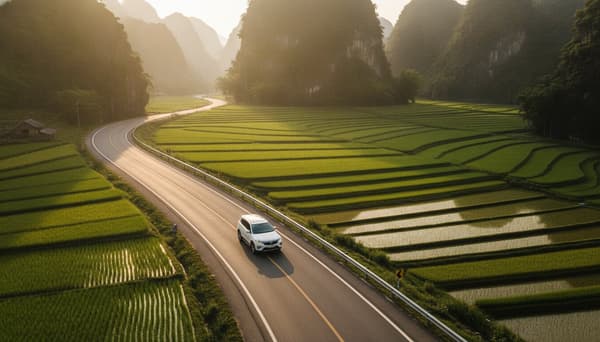
If you prepare well, you'll see a side of Vietnam most tour-bus tourists miss: the roadside pho stands, the hidden beaches, the rice-paddy backroads. If you show up unprepared, you'll be stressed, risk fines, and wish you'd chosen another way to get around. Plan accordingly. Our safe self-drive checklist and self-drive travel guide cover the same ground from a traveler's angle.
Need help deciding? Our team can talk through your route and driving experience before you book. If self-drive does not look like the right fit, we'll tell you honestly. Email contact@rocketcarrentalsvietnam.com or WhatsApp anytime.