
Who this guide is for
This is the definitive 2026 reference for foreign travelers self-driving in Vietnam. Whether you're a tourist planning a 2-week road trip, an expat needing long-term mobility, or a digital nomad exploring Southeast Asia — this covers every practical decision from license type to roadside breakdown.
If you want the short answer: yes, foreigners can self-drive in Vietnam legally with proper documents, but it's only a good idea if you have (a) a valid driver's license and the required paperwork, (b) experience driving in dense traffic, and (c) a clear route. For first-time Vietnam visitors staying in cities, a chauffeur service is usually the better choice.
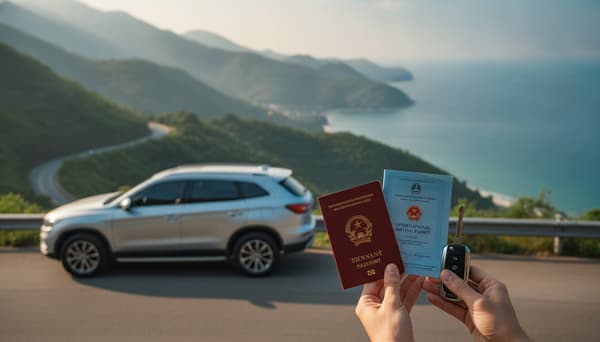
Part 1: Legal requirements (what you MUST have)
The documents every foreign driver needs in the glovebox:
- Original home-country driver's license. Held for at least one year. This is what authorizes you to drive — carry the original, not a copy.
- Passport. The physical document, not a copy or photo.
- Rental contract. Vehicle registration is handled by the rental company (typically in the glovebox).
What happens at a police checkpoint: The officer checks passport → driver's license → rental contract. Usually 5-10 minutes, documentary only. If all documents are in order, you'll be waved through. If a document is missing or expired, you'll get a fine (VND 4-6 million) and may be barred from driving until a valid license is produced.
Part 2: City-by-city difficulty rating
Not all Vietnamese cities are equally hard to drive in. Our subjective difficulty rating for first-time foreign drivers:
- Da Nang (Easy): wide roads, lane discipline, moderate traffic density. Good starter city.
- Da Lat, Sapa, Mai Chau (Easy): low density, rural roads. Just mind the mountain switchbacks.
- Phu Quoc, Mui Ne, Vung Tau (Easy): island/resort density, quiet roads.
- Hue, Nha Trang (Moderate): mid-size city traffic, manageable.
- Hanoi (Hard): dense traffic, complex one-way system, motorbike density. Old Quarter is a maze — avoid self-driving there.
- Ho Chi Minh City (Very Hard): 7 million motorbikes, permanent rush hour, 1-way streets change direction daily. Even locals have trouble. Strongly consider chauffeur instead.
Part 3: Insurance — what's actually covered
Our standard rental includes:
- Collision Damage Waiver (CDW): covers you up to VND 5M deductible for vehicle damage.
- Third-party liability: up to VND 150M if you cause property damage or injury to others.
- Passenger accident: up to VND 50M per seat.
NOT covered: tire damage on sharp objects, undercarriage damage from flooding (common in Hanoi/Hoi An after storms), damage under the influence of alcohol (Vietnam has 0% tolerance), damage when unauthorized drivers are behind the wheel.
For extra peace of mind, we offer Zero-Deductible CDW at +USD 5/day. Recommended for first-time Vietnam drivers.
Part 4: Pickup workflow — what happens when you arrive
- Documents check (10 min): home license, passport, credit card.
- Vehicle inspection (15 min): walk-around with our staff, photo-document any existing damage. Keep a copy of the inspection report.
- Deposit hold: credit card authorization for USD 300-500 depending on vehicle class. Refunded at return.
- Contract signing: bilingual EN+VI contract. Read the fuel policy, mileage limits, and late-return penalties.
- Vehicle handoff: we brief you on local traffic quirks, GPS setup, emergency contact numbers. 24/7 hotline is printed in the contract.
Part 5: Driving etiquette — the unwritten rules
Vietnamese traffic has conventions that aren't in any manual. Understanding these prevents 90% of foreigner-driver anxiety:
- Give way to bigger vehicles. Buses don't brake for cars; cars don't brake for motorbikes. Your turn at intersections is what you can safely take.
- Honk before overtaking. Not aggression — a courtesy alert. Small "beep" when passing, longer honk when approaching blind corners.
- Motorbikes flow like water. They fill every gap. Maintain 1-meter buffer; use mirrors continuously.
- Don't brake suddenly. The motorbike behind you may not have room to stop.
- Yellow light = stop. Don't try to "rush through" — Hanoi camera fines are automatic.
- Flash headlights means "I'm coming through" at narrow passes and rural roads. Not "please go" like in Europe.
Part 6: When you should NOT self-drive
Be honest with yourself. Self-drive is NOT for you if any of these apply:
- You've never driven in a motorbike-dense city.
- You're staying 2-3 days in only Hanoi or HCMC. Grab/chauffeur is more efficient.
- You're not comfortable navigating without English road signs. (Vietnamese signs are standardized internationally but locally-informed navigation requires familiarity.)
- You're planning a wine-and-dine trip. Zero alcohol tolerance means even one beer 3 hours ago disqualifies you.
For these cases, our with-driver service is USD 60-120/day including an English-speaking professional who knows the roads. Often cheaper than accumulated taxi/Grab costs + eliminates all legal risk.
Part 7: Breakdown / accident protocol
If your rental car breaks down:
- Pull over safely, turn on hazards.
- Call our 24/7 hotline (printed in contract). Describe location + symptoms.
- We dispatch a replacement vehicle or tow truck (30-90 min response in metro areas).
- Don't attempt roadside repair yourself — voids warranty and may worsen damage.
If you're in an accident:
- Check for injuries first. Call 115 (ambulance) if anyone is hurt.
- Call 113 (police) — Vietnamese law requires police report for insurance claims.
- Call us. We coordinate with police + insurance. Do NOT admit fault or pay bribes to resolve "on the spot" — always insist on official documentation.
- Don't leave the scene until police arrive.
Part 8: Route planning — most-driven foreigner routes 2026
These are the routes we book most often for self-drive customers:
- Da Nang → Hoi An → Hue: the classic central Vietnam triangle, all easy roads, 1-2 days. Perfect starter.
- HCMC → Mui Ne → Dalat: southern mountain-beach combo, 4-5 days.
- Hanoi → Sapa: via CT05 expressway, 6 hours. Last 30km of mountain switchbacks.
- Hanoi → Ha Giang Loop: advanced drivers only, 3-4 days, rewarded with Vietnam's most dramatic scenery.
- HCMC → Mekong Delta: day trip or overnight. Easy roads, flat terrain.
See our dedicated route guides for step-by-step driving directions, rest stops, and what to see along the way.
Bottom line
Self-driving in Vietnam as a foreigner in 2026 is entirely viable with the right preparation. The key decisions: (1) have your license and documents ready before arrival, (2) pick manageable cities for your first drive, (3) factor traffic anxiety honestly into your choice of self-drive vs chauffeur.
If you prepare well, you'll see a side of Vietnam most tour-bus tourists miss: the roadside pho stands, the hidden beaches, the rice-paddy backroads. If you show up unprepared, you'll be stressed, overpay for tickets, and wish you'd booked a driver. Plan accordingly.
Need help deciding? Our team pre-screens every self-drive booking. If we think your trip is better served by a chauffeur, we'll tell you honestly — no upsell. Email contact@rocketcarrentalsvietnam.com or WhatsApp anytime.